 By Apollo Kokkinopoulos, CEO
 If you operate a business in Texas, electricity is likely one of your largest monthly operating expenses. Between scorching summers that push HVAC systems to their limits and the complexities of the deregulated ERCOT market, many Texas businesses end up paying far more than they should for commercial electricity. The good news is that there are concrete, actionable strategies you can implement right now to bring those costs down significantly.
Whether you manage a single storefront or a multi-site commercial portfolio, the principles are the same. Understanding how your bill works, being proactive about your contract, managing when and how you use power, and working with the right partners can reduce your electricity spend by 15-25% or more annually. Here is how to make that happen.
Understand How Your Commercial Bill Actually Works
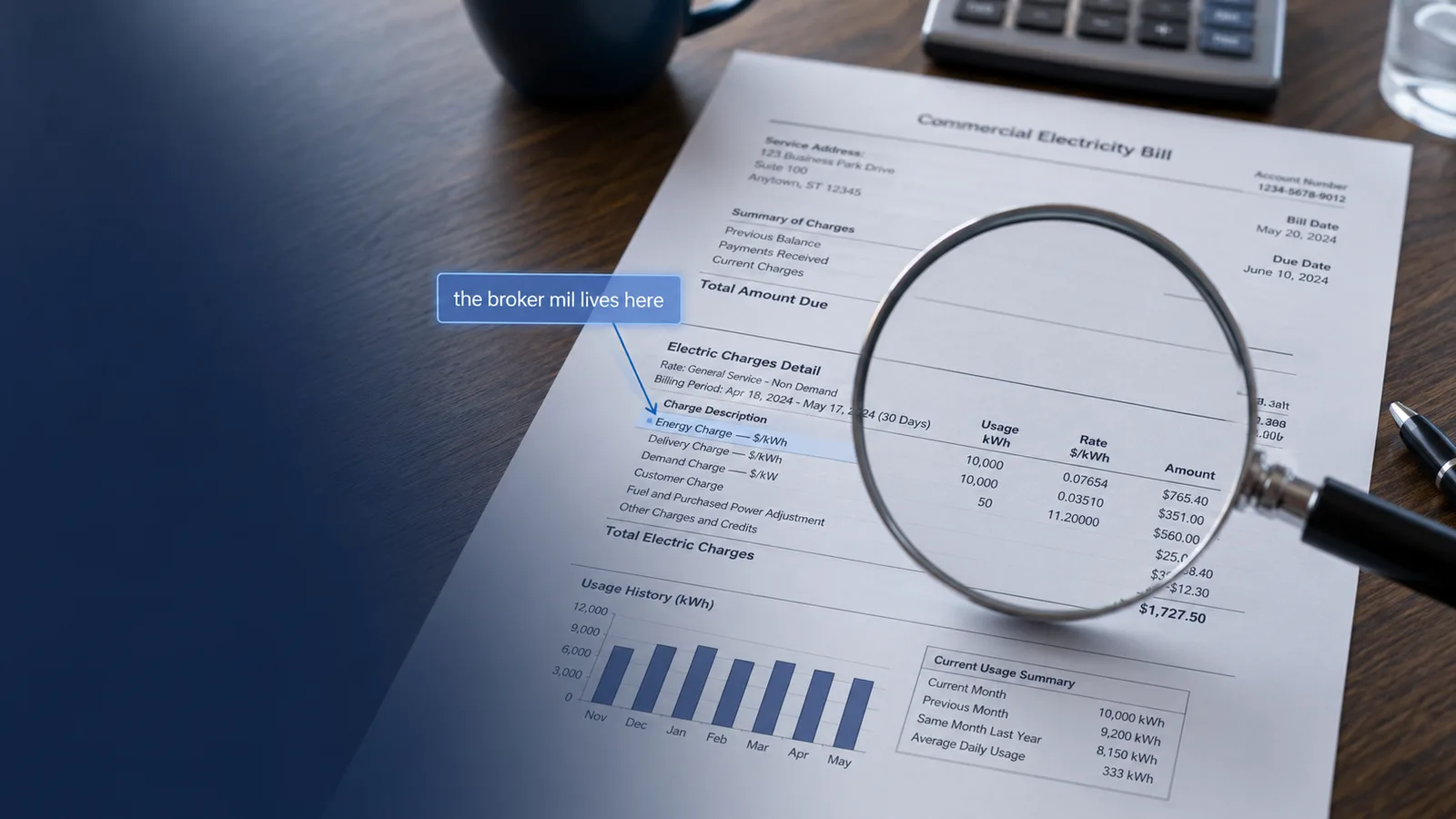
The first step to lowering your electricity bill is understanding what you are actually paying for. Most business owners glance at the total amount due and move on. But a commercial electricity bill in Texas is made up of several distinct charges, and each one represents a potential opportunity for savings.
Your bill typically includes these components:
- Energy charge — This is the cost per kilowatt-hour (kWh) of electricity consumed. It is the rate you negotiated (or were defaulted into) with your Retail Electric Provider (REP).
- Demand charge — Measured in kilowatts (kW), this reflects the highest amount of power your facility drew during any 15-minute interval in the billing period. For many commercial accounts, demand charges represent 30-40% of the total bill.
- TDU delivery charges — Your local Transmission and Distribution Utility (TDU) charges for delivering electricity to your meter. These are regulated and pass-through, but they can still contain errors worth catching.
- Ancillary and miscellaneous fees — These include charges for grid reliability, renewable energy credits, metering, and other regulatory line items.
When you understand each component, you can target the specific areas where your business is overspending rather than just hoping for a lower total number.

Negotiate Your Rate — Do Not Auto-Renew
This is the single most impactful action most Texas businesses can take, and it is also the one most frequently overlooked. When your electricity contract expires, your REP does not simply continue at the same rate. In most cases, you are rolled onto a significantly higher month-to-month or holdover rate that can be 20-50% above what you were previously paying.
REPs are counting on you being too busy to notice. And for many business owners, that is exactly what happens. The contract quietly expires, the rate jumps, and months go by before anyone catches it.
The fix is straightforward: begin shopping for a new contract 90 to 120 days before your current agreement ends. This gives you enough time to solicit competitive bids from multiple suppliers, compare rate structures, and negotiate terms without the pressure of an imminent expiration. Suppliers offer forward pricing — rates locked in today for a start date weeks or months out — but those offers have limited windows. Waiting until the last week before your contract expires means fewer options and less leverage.
If you are not sure when your contract ends, that alone is reason enough to schedule a bill review.
Manage Your Peak Demand
For commercial accounts, demand charges are often the hidden driver of high electricity bills. Unlike residential customers who pay primarily based on total consumption, commercial customers are also billed for the highest rate of power they draw at any point during the month.
Here is how it works: your meter measures electricity usage in 15-minute intervals. The single highest interval in a billing period sets your demand charge for the entire month. That means if your facility draws 200 kW for most of the day but spikes to 350 kW for just 15 minutes when all your equipment starts up simultaneously in the morning, you are billed for 350 kW of demand all month.
Strategies to reduce peak demand include:
- Stagger equipment startup. Instead of turning on HVAC, lighting, refrigeration, and production equipment all at once, bring systems online sequentially over 30-45 minutes. This alone can reduce your peak demand by 15-25%.
- Shift non-essential operations off-peak. If you can run certain processes during early morning or late evening hours, you reduce the likelihood of setting a new demand peak during the middle of the day.
- Pre-cool your facility. Run HVAC aggressively during early morning hours (when electricity prices and demand are lower), then let the building coast through the afternoon peak.
- Monitor in real time. Smart meter data and energy management systems allow you to see demand in real time and make adjustments before you set a costly new peak.
Even a modest 10-15% reduction in peak demand translates directly to lower monthly bills, month after month. Our guide to reading your commercial electricity bill walks through every line item so you can spot these charges.
Audit Your Bills Regularly
Billing errors are more common than most business owners realize. TDUs process millions of meter reads and billing transactions monthly, and mistakes happen. Incorrect meter multipliers, wrong rate codes, estimated reads that are never corrected, charges for services that were disconnected — these are all real issues that our team encounters on a regular basis when reviewing client bills.
A professional bill audit can uncover thousands of dollars in overcharges that have been accumulating for months or even years. In many cases, credits can be applied retroactively.
Even if your bills are accurate, a periodic audit helps you understand your usage patterns. Seasonal trends in your consumption and demand data can reveal opportunities to shift operations, adjust thermostat schedules, or renegotiate your rate structure to better match how your business actually uses electricity.
Many businesses treat their electricity bill as a fixed cost that cannot be changed. In reality, it is one of the most controllable operating expenses you have — if you are willing to look at the details.

Consider Your Rate Structure Carefully
Not all electricity contracts are created equal, and the rate structure you choose has a significant impact on your bottom line. Texas commercial customers typically have three options: fixed rate, variable (index) rate, and hybrid rate.
A fixed rate locks in your per-kWh price for the duration of your contract, providing budget certainty. A variable rate floats with the ERCOT wholesale market, which can be cheaper during mild months but expensive during summer peaks and extreme weather events. A hybrid rate blends both approaches under a single contract.
The right choice depends on your business's risk tolerance, budget requirements, and usage patterns. A facility with stable, predictable consumption might benefit from locking in a competitive fixed rate. A high-volume industrial operation with flexibility to shift production may save more on an index rate. Many businesses find that a hybrid approach gives them the stability they need while still capturing market upside.
Choosing the wrong rate structure for your business is one of the most expensive mistakes you can make — and it is one you are locked into for the duration of your contract. We cover this topic in depth in our guide to fixed vs. variable rate electricity.
Work With an Energy Broker
The Texas electricity market is competitive, and that competition benefits businesses — but only if you know how to take advantage of it. With over 25 licensed REPs offering a wide range of plans, rate structures, and contract terms, finding the best deal on your own is time-consuming and often leaves money on the table.
An energy broker does this work for you. A good broker collects your usage data, solicits bids from multiple suppliers simultaneously, and presents your options side by side so you can make an informed decision. The broker is paid by the supplier, not by you — so there is no cost to your business for the service.
Beyond the initial contract, the best brokers provide ongoing support: tracking your contract expiration dates, monitoring market conditions for renewal timing, auditing your bills for errors, and serving as your advocate when issues arise with your provider. This kind of continuous attention is what separates a one-time transaction from a long-term partnership that consistently saves you money.
If you are interested in understanding the full value a broker brings, take a look at our article on why Texas businesses use energy brokers instead of going direct.
Start Taking Control of Your Energy Costs
Lowering your commercial electricity bill in Texas is not about any single silver bullet. It is about a combination of understanding your bill, being proactive about your contract, managing how and when you use power, and working with professionals who know the market inside and out.
The businesses that consistently pay the least for electricity are not the ones who simply picked the cheapest rate one time. They are the ones who treat energy as a managed expense — with regular audits, strategic contract timing, thoughtful rate structure selection, and expert support.
Every month you wait is another month of paying more than you need to.
Not Sure Where to Start?
Schedule a free bill audit with Elite Energy Consultants. We will review your current contract, check for billing errors, and show you exactly where the savings are.
Schedule a Free Bill Audit