 By Apollo Kokkinopoulos, CEO
 Texas is one of the few states in the country with a fully deregulated electricity market. That means businesses operating within the ERCOT grid have the freedom to choose their Retail Electric Provider (REP) — a significant advantage that can translate into real savings on one of your largest operating expenses.
But freedom of choice comes with complexity. There are more than 25 licensed REPs serving the Texas commercial market, each offering dozens of plans with varying rate structures, contract terms, and fee schedules. Navigating this landscape on your own is time-consuming, and without market expertise, it is easy to leave money on the table. That is why a growing number of Texas businesses — from single-location restaurants to multi-site industrial operations — work with energy brokers rather than going directly to providers.
What Does an Energy Broker Actually Do?
An energy broker acts as an intermediary between your business and multiple electricity suppliers. Rather than you contacting each REP individually to request pricing, your broker handles the entire process on your behalf.
Here is how it typically works:
- The broker collects your usage data. This includes your historical consumption (usually 12 months of usage history), your current rate and contract terms, your meter information, and your TDU service area.
- The broker solicits competitive bids. Using your usage profile, the broker requests pricing from multiple suppliers simultaneously. This creates a competitive bidding environment — suppliers know they are competing against each other, which drives prices down.
- The broker presents your options. You receive a side-by-side comparison of bids from multiple suppliers, including the rate per kWh, contract length, rate structure (fixed, variable, or hybrid), and any fees or special terms.
- You choose. The broker explains the options and makes recommendations based on your business's needs, but the final decision is always yours.
- The broker manages the transition. Once you select a supplier, the broker handles the contract execution and coordinates with ERCOT for the switch. There is no interruption to your service.
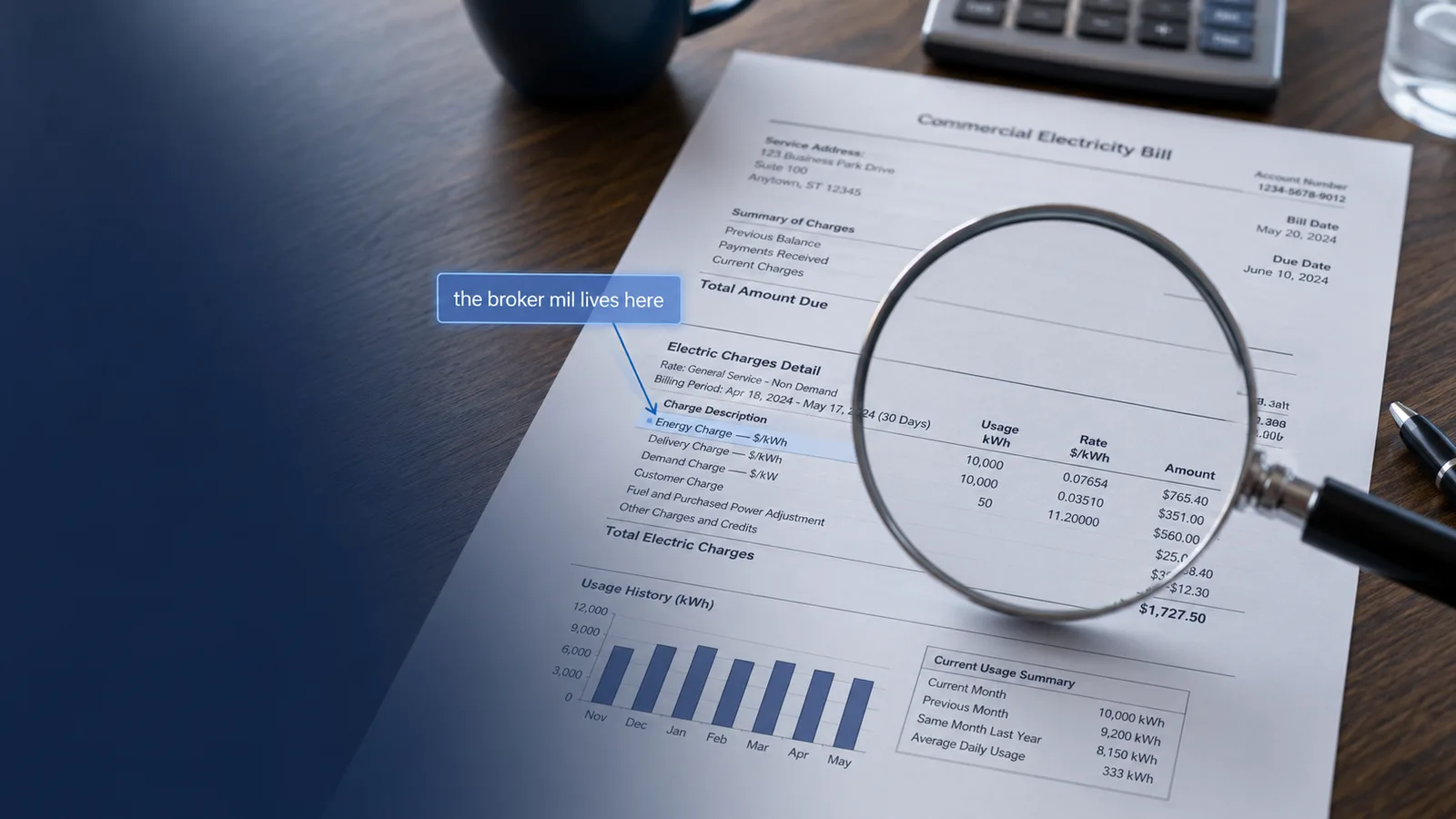
The most important thing to understand is that the broker is paid by the supplier, not by you. REPs build a small commission into their pricing to compensate the broker. This is the same commission structure that exists whether you go through a broker or not — when you go direct, the REP's internal sales team earns that same margin. Using a broker does not add cost to your bill.

The Problem With Going Direct
When you contact a REP directly, you are dealing with a sales representative whose job is to sell you that company's product. They are not going to tell you that a competitor offers a better rate for your usage profile. They are not going to suggest that a different rate structure — one their company may not offer — would be a better fit for your business.
Going direct to a single provider means:
- You only see one company's pricing. Without competitive bids, you have no way to know whether the rate you are being offered is competitive or inflated. The REP has no incentive to give you their best price if they know you are not comparing alternatives.
- You lack market context. Is the rate you are being quoted high relative to current market conditions? Is it a good time to lock in a fixed rate, or would you be better served waiting? Without market expertise, you are making a significant financial commitment based on limited information.
- You miss wholesale relationships. Brokers who manage large portfolios of commercial accounts have volume leverage with suppliers. They can often access pricing tiers that are not available to individual businesses calling in on their own.
- You are on your own after signing. Most REP sales representatives move on to the next prospect after closing the deal. If you have billing issues, need to dispute a charge, or want to explore options before your next renewal, you are navigating the system alone.
5 Reasons Businesses Use Energy Brokers
- Access to 25+ suppliers in a single conversation.
Instead of making a dozen phone calls and comparing incompatible quotes, your broker presents standardized bids from every major REP in the Texas market. You see the full picture in one place and can compare apples to apples.
- Market expertise you do not have in-house.
Energy brokers understand rate structures, contract terms, ERCOT market dynamics, and the fine print that most business owners do not have time to learn. They know which suppliers have the best track records, which contract provisions to negotiate, and which fees to watch out for. This is the same kind of expertise you expect from your accountant or your insurance broker — specialized knowledge applied to your benefit.
- Ongoing support beyond the initial contract.
The best brokers do not disappear after you sign. They track your contract expiration dates, manage your renewal process, audit your bills for errors, and serve as your advocate when issues arise with your provider. This ongoing relationship is where much of the long-term value lies — the broker is continuously working to ensure you are paying the right amount.
- Zero cost to your business.
This bears repeating because it is the most common point of confusion. The broker's commission is paid by the supplier. You do not pay a fee, a retainer, or a premium for the service. The rates you receive through a broker are competitive with — and frequently better than — what you would get going direct.
- Time savings that compound over years.
Researching suppliers, requesting quotes, comparing contracts, negotiating terms, managing renewals, auditing bills — these tasks take hours. For a business owner or facilities manager, those are hours taken away from running the actual business. A broker handles all of it, freeing you to focus on what you do best.
What to Look for in a Good Energy Broker
Not all brokers are equal. The quality of service, market access, and ongoing support varies significantly across the industry. Here are the qualities that distinguish a strong broker from a transactional one:
- Transparency. A good broker shows you all the bids they receive, not just the one with the highest commission. They explain the pros and cons of each option honestly, even if it means recommending a lower-commission product that is better for your business.
- No pressure. If a broker is pushing you to sign immediately or discouraging you from comparing their recommendations against your own research, that is a red flag. A confident broker welcomes scrutiny because they know their value proposition holds up.
- Supplier diversity. Ask how many suppliers the broker works with. A broker who only has relationships with three or four REPs cannot give you a truly competitive market comparison. Look for brokers who work with 20 or more licensed Texas suppliers.
- Ongoing service commitment. Ask what happens after you sign the contract. Does the broker manage your renewals? Do they audit your bills? Do they have a support team you can reach with questions? The initial contract is just the beginning of the relationship.
- Proven retention. Client retention rate is one of the most telling metrics for a broker. A 98% annual retention rate, for example, indicates that the vast majority of clients continue working with the broker year after year — a strong signal that the service delivers consistent, ongoing value rather than a one-time transaction.

Common Misconceptions About Energy Brokers
Despite the clear advantages, some businesses still hesitate to work with a broker. Usually, it is because of one of these misconceptions:
"Brokers add cost to my bill." This is the most persistent myth, and it is false. The broker's commission is built into the supplier's pricing structure — the same way a real estate agent's commission is built into the transaction. When you go direct, the REP does not lower the price by the amount they would have paid a broker. That margin stays with the REP's internal sales team. Using a broker does not increase your cost; it increases your access to competitive options.
"I can get the same rates going direct." In theory, you might occasionally match a broker's rate by negotiating aggressively with a single supplier. In practice, this rarely happens. Brokers have volume leverage across their entire client portfolio that gives them access to pricing tiers most individual businesses cannot reach. More importantly, without competitive bids from multiple suppliers, you have no way to know whether the rate you negotiated is actually the best available.
"I only need a broker once." This is perhaps the most costly misconception. Your electricity needs are not static. Contracts expire, market conditions change, your business's usage patterns evolve, and billing errors accumulate. A broker who manages your account on an ongoing basis ensures that you are continuously optimized — not just at the point of initial sale, but at every renewal, every market shift, and every billing cycle. Our article on lowering commercial electricity bills covers the full range of strategies that ongoing broker support enables.
See What 25+ Suppliers Would Charge for Your Business
The Texas deregulated market gives you a powerful advantage — the ability to choose your electricity provider and negotiate your terms. But that advantage only works in your favor when you have the market visibility, supplier relationships, and expertise to make the best choice.
An energy broker provides all three, at no cost to your business. Whether you are signing your first commercial electricity contract or preparing for an upcoming renewal, having a professional in your corner ensures you are seeing the full market and making an informed decision.
If the "at no cost to your business" part is the piece you want to verify before you engage anyone, our breakdown of what energy brokers actually cost in Texas shows exactly who pays the broker, how much, and why the broker-channel rate usually still beats a direct quote. For the procurement and consulting work that sits around the contract itself — bill audits, renewal timing, CSAs — see our commercial energy services.
Ready to See Your Options?
Get a free, no-obligation quote from Elite Energy Consultants. We will compare pricing from 25+ Texas electricity suppliers and show you the best options for your business.
Get A Free Quote