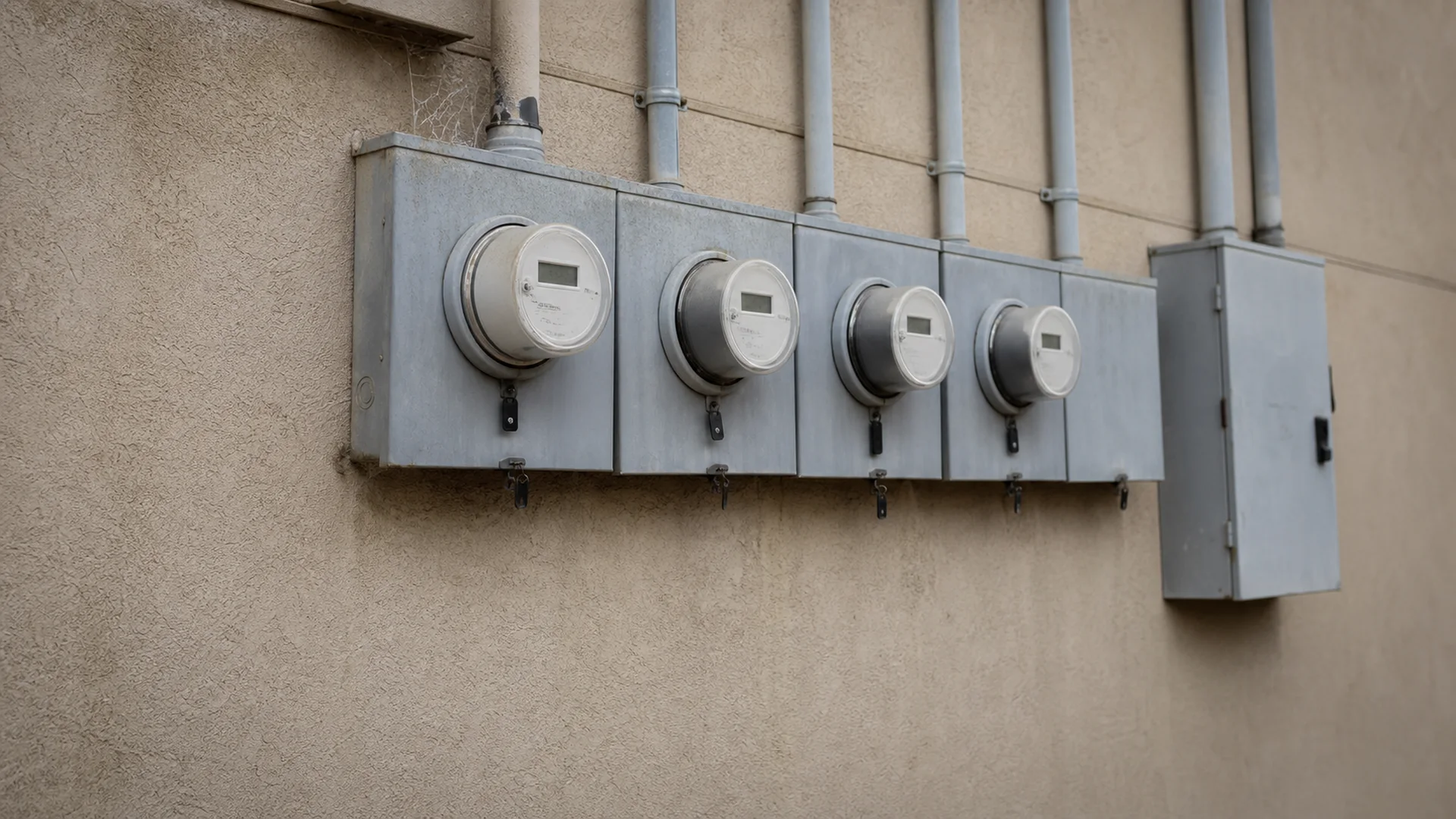
 By Apollo Kokkinopoulos, CEO
 Renewing electricity for one building is a calendar reminder. Renewing it across a portfolio is an inventory problem wearing a calendar's clothes. Twelve properties can carry sixty meters, nine suppliers, twelve unrelated end dates, four signing entities, and one budget cycle that fits none of them — and the thing that goes wrong is almost never the price negotiation. It is that nobody could produce the list in time to negotiate at all.
This is the working checklist: what to inventory, what Texas rules actually guarantee you and which of your accounts they reach, who has to sign, how to align end dates that were never meant to line up, and how to compare offers across properties that are not comparable. It assumes the meters are already classified — if that is still open, start with master-metered apartment electricity in Texas and come back.
The Inventory: One Row Per Meter
Not one row per property. Properties have many meters, and a single forgotten vacant-unit account or amenity meter is exactly the kind of thing that quietly sits on holdover for two years. Build this as a spreadsheet, one line per ESI ID.
| Field | Why it's on the list |
|---|---|
| Property + service address | Confirms the account belongs to a property you still own |
| Contracting entity | The party that signs. Often a single-purpose entity per property |
| ESI ID | What suppliers actually price. One property holds many |
| Meter role | Master, common area, amenity, vacant unit, unmetered lighting |
| TDU + rate schedule | Determines the delivery charges no supplier can discount |
| 12 months of kWh | Seasonality is most of a Texas load story; one month tells you nothing |
| Peak demand (kW or kVA) | Sets the demand line, and decides small-commercial status |
| Current supplier + product type | Fixed, variable, indexed, or holdover |
| Contract end date | The date everything else keys to |
| Notice / opt-out window | An auto-renewal you failed to exit is worse than an expiry you missed |
| Termination provision | What leaving early costs, usually tied to remaining volume |
| Authorized signer | Per entity, established before you need it |
Two practical notes. Unmetered accounts — site lighting on a lighting-service schedule — will have no usage to pull, because there is no meter; their consumption is a deemed figure from the TDU's tariff, and they still get supplied and still belong on the list. And accounts in Austin or San Antonio belong in a separate section marked not contestable: those municipal territories are outside retail choice. Lubbock is the exception, having voluntarily entered choice, so Lubbock properties do belong in the shoppable set.
What Texas Rules Guarantee — and Which of Your Meters Get It
This is the part that most portfolio guidance gets wrong, usually by describing protections that only some of the accounts actually have.
PUCT §25.475 sets out the expiration and renewal rules, and it applies to residential and small commercial customers. "Small commercial customer" is defined in PUCT §25.471(11) as "a non-residential customer that has a peak demand of less than 50 kilowatts during any 12-month period, unless the customer's load is part of an aggregation program whose peak demand is in excess of 50 kilowatts during the same 12-month period."
Read that second clause twice, because it is the trap this whole exercise walks into. Aggregating your meters to win better pricing is precisely the thing that can push the combined load above 50 kW and out of small-commercial status. The individual leasing-office meter that qualified on its own may not qualify as part of the block. And §25.471(a)(3) provides that a customer other than a residential or small commercial customer — or a non-residential customer whose load is part of an aggregation in excess of 50 kilowatts — "may agree to terms of service that reflect either a higher or lower level of customer protections than would otherwise apply." A short list of provisions cannot be waived; the expiration-notice rules of §25.475 are not among them.
None of that is an argument against aggregating. Aggregation is usually the right call, and the pricing benefit is the reason the portfolio approach exists. It is an argument for knowing that the protections you were relying on may not travel with the accounts, and for replacing them with something you control — a diary, a named owner, and a contract you actually read.
For the accounts that do qualify
- Three notices, not one. §25.475(e)(1)(A) requires at least three written notices of the expiration date, provided during the last third of the contract period and spread as evenly through it as practicable. For contracts of twelve months or longer, the first may come up to three months before the end date.
- A 14-day floor for small commercial. Under §25.475(e)(1)(A)(iii), "for a small commercial customer, the final notice must be provided at least 14 days before the fixed rate contract will expire." The general non-residential floors are 30 days for contracts longer than four months and 15 days for four months or fewer.
- A fee-free default. §25.475(e)(2)(A): if the customer takes no action, the REP must serve them on "a default renewal product that is a month-to-month product that the customer may cancel at any time without a fee." That price may vary between billing cycles — fee-free is not the same as cheap.
- Terms disclosed in advance. The contract itself must state the terms of the default renewal product the customer will be enrolled in if they do not select another product.
- No indexed products. §25.475 prohibits a REP, aggregator, or broker from offering an indexed product to a residential or small commercial customer on or after February 1, 2022, and a wholesale indexed product on or after September 1, 2021. A large portfolio may lawfully be offered structures its own small meters may not.
The remedy almost nobody claims
Under §25.475(e)(1)(C), if the REP did not provide the required expiration notice and the customer did not select another product before the term ended, "the REP must continue serving the customer under the terms of the fixed rate contract until the REP provides notice in accordance with applicable requirements... or until the customer selects another retail electric product."
That is worth acting on. If an account rolled to an expensive month-to-month rate and nobody at the property can produce the notices, the question of whether proper notice was given is a live one, and the rule's answer is that the old contract price should have continued. Notices are delivered by mail to the billing address on file unless the customer opted into electronic delivery — which is exactly why portfolios with staff turnover and stale billing addresses end up in this position. Keep the notices when they arrive. They are evidence.
Meter Classification, in One Table
Enough to run the renewal. The full treatment — including submetering, allocation, and All Bills Paid economics — is in the master-metered apartment guide.
| Meter | In the renewal? | Renewal note |
|---|---|---|
| Occupied resident unit | No | Resident's own account |
| Common area / amenity | Yes | Often individually under 50 kW — check status after aggregation |
| Vacant unit (holdover) | Yes | Opens and closes constantly; needs a standing arrangement, not per-unit decisions |
| Unmetered site lighting | Yes | No usage history to pull; deemed kWh from the TDU tariff |
| Master meter / All Bills Paid | Yes | Largest volume, longest lead time, almost certainly above 50 kW |
Renewal Authority: Settle It Before You Need It
Multifamily ownership is structured, and supply contracts bind entities rather than buildings. A portfolio under one management brand may hold each property in a separate single-purpose entity with a different signer, different joint-venture consent requirements, and different approval thresholds.
Establish three things per property while building the inventory: which entity holds the account, who can bind that entity, and what the property management agreement permits the manager to commit to without owner approval. That last one catches people — management agreements frequently cap the term length or dollar value a manager may sign for, and a 36-month supply contract on a master meter can exceed a cap written with service vendors in mind. Discovering that during the final week before expiration is how a portfolio ends up on holdover with a signed offer sitting unexecuted.
Budget Cycles and the Timing Argument
Two calendars are in play and they rarely agree. The contract calendar is set by whenever each property last signed. The budget calendar is set by the owner's fiscal year, and for most multifamily operators the operating budget is built in the autumn for the following year.
The useful move is to make them serve each other rather than fighting. Renewals settled before budgets are locked give you a real supply number to budget with instead of an escalator applied to last year. Renewals that land after budgets are locked mean a variance conversation regardless of how good the price was. Where a portfolio is converging its end dates onto one target anyway, choosing a target that sits a comfortable distance ahead of the budget build turns the alignment exercise into a budgeting improvement as well as a procurement one.
Aligning Expirations Without Wrecking the Pricing
Alignment is achieved with bridging terms, not uniform terms. An account with twenty months remaining is left alone. An account three months out signs something short that carries it to the chosen common date. Over one or two cycles the portfolio converges.
Be honest about the trade. A blend of term lengths will not all price at the best available point, and forcing a short bridge through an unfavorable market costs real money in exchange for administrative tidiness. Alignment is worth it when the portfolio is large enough that combined volume changes the offers you see, and when the current state is genuinely unmanaged. It is worth less when a portfolio is small, already tracked, and would have to buy its way out of good contracts to get there. Our single-account guide to when to renew a commercial electricity contract covers the timing question for one meter; this is the multi-meter version of it.
Comparing Offers Across Properties That Aren't Comparable
Portfolio offers arrive in shapes that resist side-by-side reading. Some price every account at one blended figure; some price each ESI ID; some quote a headline number and pass through charges separately. Before comparing anything, normalize:
- Same accounts. Confirm every offer covers the identical ESI ID list. An offer that quietly excludes the two worst-load-factor meters is not cheaper, it is smaller.
- Same term and the same start. Different start dates are different markets.
- Same treatment of pass-throughs. Establish what is inside the number and what arrives as a separate line — capacity, ancillary services, transmission, ERCOT charges. Our explainer on capacity versus energy charges covers what these are.
- Same usage assumption, and check the bandwidth or swing tolerance. Multifamily consumption moves with occupancy; an offer with a narrow tolerance can penalize a lease-up or a renovation.
- Delivery charges excluded from the comparison entirely. Regulated TDU charges are identical whoever supplies you — see Texas TDU delivery charges. Any "savings" claimed on that half of the bill is not a real difference between offers.
- Termination and assignment language, especially for properties that might trade during the term.
Then read the renewal provision of whatever you are about to sign, so the next cycle starts from a diary entry rather than a surprise.
Acquisitions and Dispositions Mid-Term
Portfolios transact, and contracts do not follow the deed. On an acquisition, electricity belongs on the diligence list: every ESI ID at the property, the supplier, the end date, whether the contract is assignable and on whose consent, and what termination would cost. A property can arrive already on holdover, and that cost will not be in the offering memorandum. On a disposition, termination exposure is typically tied to remaining contracted volume, so establish the number early. Either way, contract term deserves to be tracked as an asset-level attribute next to loan maturities rather than as a facilities note on one manager's desk.
The 90-Day Runbook
Once the inventory exists, each cycle runs on a repeatable schedule. Counting back from the earliest expiration in the group:
Day 90 — Freeze the list
Reconcile the inventory against current ownership: properties sold come off, properties acquired come on, vacant-unit accounts are re-counted. Confirm the signer for each entity is still the signer.
Day 75 — Assemble the data pack
Twelve months of usage per account, peak demand where applicable, current product and end date. This is the package a supplier prices; incomplete data gets priced conservatively, which costs you more than the delay would have.
Day 60 — Go to market
One request, one account list, one term structure, sent to a real panel of suppliers rather than to the incumbent alone. A renewal offer from your current supplier is a negotiating position, not a benchmark.
Day 45 — Normalize and compare
Apply the comparison discipline above. Offers in commercial supply markets are typically time-limited, so have the decision-maker available rather than discovering an approval chain after the pricing lands.
Day 30 — Execute
Sign with the confirmed authorized signer for each entity. Leave room for the switch to process — establishing service with another REP can take up to seven business days under PUCT rules, and the change generally takes effect on a billing cycle.
Day 0 and after — Close the loop
Record the new end date, the notice window, and the termination terms in the inventory the same day you sign. File the expiration notices as they arrive. The next cycle should begin from a diary entry, not from a bill that looked wrong.
Frequently Asked Questions
When should an apartment portfolio start its electricity renewal?
Earlier than a single account would. A single meter is commonly shopped three to four months out. A portfolio needs that window for the market work plus the time to assemble the inventory, confirm who can sign for each entity, and reconcile end dates — so six to nine months before the earliest expiration is a realistic start for a first cycle. PUCT §25.475 requires a REP to send its three expiration notices during the last third of a fixed-rate contract, and for contracts of twelve months or longer the first may come up to three months before the end date. If your process starts when that notice arrives, the inventory work has already made you late.
How much notice does a Texas supplier have to give before a contract ends?
For fixed rate products, PUCT §25.475(e)(1)(A) requires at least three written notices spread through the last third of the contract term. The final notice must arrive at least 30 days before expiration for contracts longer than four months, at least 15 days for contracts of four months or fewer, and at least 14 days before expiration for a small commercial customer. Two caveats matter for apartment portfolios. The rule reaches residential and small commercial customers — defined in §25.471 as non-residential with peak demand under 50 kW in any 12-month period — so larger accounts are not covered by it. And under §25.475(e)(1)(B) notices go by mail to the billing address on file unless you opted into electronic delivery.
What happens if an apartment electricity contract lapses?
Service continues; the price changes. For a qualifying small commercial account where the REP gave proper notice, §25.475(e)(2)(A) requires the default to be a month-to-month product the customer may cancel at any time without a fee — though that price may vary between billing cycles. Accounts above the small-commercial threshold get whatever the contract itself specifies, which can include an automatic renewal term with a termination fee. There is also a remedy worth knowing: under §25.475(e)(1)(C), if the REP did not provide the required notice and the customer did not select another product, the REP must keep serving the customer under the terms of the fixed rate contract until proper notice is given. Our guide to what happens when a commercial electricity contract expires covers this in general terms.
Can apartment properties with different end dates be put on one contract?
Not retroactively, and not by signing identical terms. Accounts under contract have to run out or be bought out, so alignment is achieved with bridging terms — a property three months from expiration signs something short that carries it to a chosen common date, while a property with twenty months left is left alone until its own window opens. Over a cycle or two the portfolio converges on one date. The trade is real: a blend of term lengths will not all price at the best available point, and you are buying negotiating leverage and administrative control with some price optimization.
Who has authority to sign an apartment electricity renewal — owner, asset manager, or property manager?
Whoever can bind the entity that holds the account, which is a legal question about the ownership structure rather than a question about job titles. Multifamily portfolios commonly hold each property in its own single-purpose entity, so a signature valid at one property may be invalid at the next even under one management company. Property management agreements often cap the term or dollar value a manager can commit to without owner approval, and a multi-year supply contract can exceed that cap. Establish the signer per entity during the inventory, not during the week the contract expires.
What happens to an apartment electricity contract when a property is acquired or sold?
It does not follow the real estate automatically. A supply contract binds the contracting entity, so a transaction generally requires an assignment the supplier consents to, or a termination whose fee may be tied to the remaining contracted volume. On acquisitions, add every ESI ID, supplier, end date, assignment clause, and termination provision to the diligence list — a property can arrive already on holdover. On dispositions, price the termination exposure early rather than in the final week of closing.
The Bottom Line
A portfolio renewal is won or lost before any supplier is contacted. The inventory is the deliverable — one row per meter, with the end date, the signer, and the termination terms filled in — and everything after it is comparatively easy. The rules help where they apply, and the 50 kW line decides where that is, with the uncomfortable twist that aggregating for a better price can move accounts across it.
Build the list once. Then the annual exercise is a diary entry, a data pull, and a negotiation with all of your volume behind it, instead of a scramble triggered by a bill that looked wrong.
Request a Multi-Property Renewal Review
Send us a recent bill for each property and we'll build the meter inventory, map every contract end date onto one calendar, flag the accounts already on holdover, and show you what the market currently offers a portfolio shaped like yours. Elite Energy Consultants shops 25+ retail providers, and we're paid by the provider — not by you.
Request A Multi-Property Renewal ReviewStill working out which meters belong in the renewal at all? Start with apartment common-area electricity for the meter-by-meter inventory, or our multi-family and apartment page for how portfolio procurement works.
Advise apartment owners? Management companies, asset managers, and multifamily brokers who bring Elite to their client base earn on every account placed — and those clients get the renewal review at no cost. Partner with us.