 By Apollo Kokkinopoulos, CEO
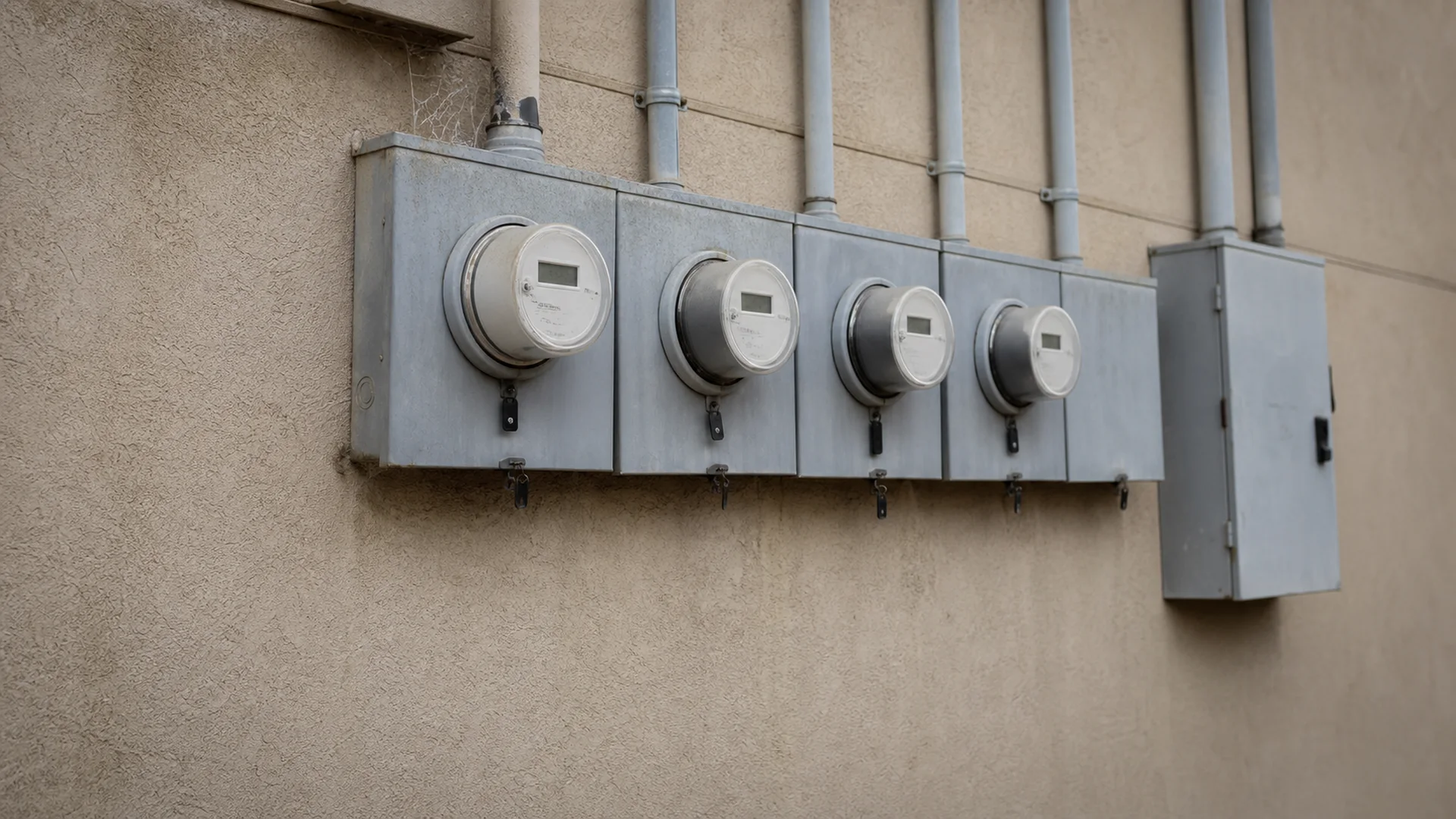
 Ask most people who runs the electricity at an apartment community and you will hear some version of "the residents do." It is half true, and the missing half is expensive. Residents hold their own accounts for their own units. The property holds a second set of accounts nobody in the building thinks about: the leasing office, the clubhouse, the fitness center, the corridors and breezeways, the parking lot and site lighting, the pool equipment, the laundry room, the access gates, the elevators, the irrigation controller, the maintenance shop, and every unit sitting vacant with the power still on in the property's name.
Those are commercial electricity accounts. They run around the clock, they sit entirely inside the property manager's authority, they are in a deregulated market where the supplier can be changed — and at a great many Texas properties they have never once been put out to bid. This guide covers which accounts are yours, why they cost more than their size suggests, and how to take them to market without touching a single resident.
The Two Electricity Worlds Inside One Apartment Community
Every meter on the site belongs to somebody. The only question that matters for procurement is whose name is on it — because the customer of record is the only party who can change the supplier.
| Account type | Customer of record | Typical load pattern | Can the property shop it? |
|---|---|---|---|
| Occupied resident unit | The resident | Evenings and weekends, heavy summer cooling | No — the resident's own account |
| Vacant unit | The property, on holdover | Low but continuous; HVAC held at a setpoint | Yes |
| Leasing office / clubhouse / fitness | The property | Business hours plus overnight HVAC and standby | Yes |
| Corridors, stairwells, breezeways | The property | Near-flat 24/7 | Yes |
| Site and parking lighting | The property | Dusk to dawn, every night | Yes — often unmetered, see below |
| Pool, laundry, gates, elevators, irrigation | The property | Cyclical, seasonal, some 24/7 | Yes |
| Master meter (whole building) | The property | Everything, resident consumption included | Yes — see the master-metered guide |
Everything in the "yes" column is a commercial account in a competitive market. Nothing in the "no" row is affected by anything you do to the rest.
Every Common-Area Meter on a Typical Texas Property
The point of a checklist is that you will find accounts you had forgotten existed. Work the site physically rather than working from a bill stack — the bills you have are, by definition, the accounts you already know about.
- Leasing office. HVAC, lighting, workstations, signage. Usually the largest single common-area account on a garden-style property.
- Clubhouse and community room. Conditioned space that is heated and cooled whether or not anyone books it.
- Fitness center. Equipment plus continuous cooling; often the highest load factor on the site because it is conditioned overnight.
- Corridors, stairwells, and breezeways. Lighting that never turns off, plus corridor HVAC in interior-hallway buildings.
- Site and parking lighting. Pole lights, wall packs, bollards, carport and garage lighting. See the next section — a good share of this may have no meter at all.
- Pool pumps and heaters. Circulation runs on a timer year-round; heaters are a seasonal step change that can move an account into a different rate class.
- Laundry room. Washers, dryers, ventilation, and lighting — regardless of whether a third-party vendor owns the machines, the meter is usually the property's.
- Access gates and call boxes. Small, continuous, and almost always missed.
- Elevators. Standby draw plus cab lighting and ventilation between trips.
- Irrigation controllers and well or booster pumps. Seasonal, and on larger sites not small.
- Maintenance shop and storage. Tools, compressors, a shop HVAC unit, and often a second refrigerator nobody logged.
- Trash compactors and valet-trash equipment. Intermittent but high draw when they run.
- Vacant-unit holdover accounts. The line most often missed entirely — see below.
The Vacant-Unit Line Nobody Budgets
When a resident moves out and closes their account, service at that unit does not stop. It reverts to the property so the unit can be shown, turned, and conditioned — and it stays there until the next resident establishes service. At a stabilized property that is a handful of units at any moment. During lease-up, a heavy turn season, or a renovation, it can be a great many more, each one carrying a customer charge, a metering charge, and whatever supply rate the property's holdover arrangement happens to be.
Two things make this worse than it sounds. The unit is usually being held at a setpoint in a Texas summer, so it is not a trivial load. And because these accounts open and close constantly, they are the ones least likely to sit under a negotiated contract — they get established quickly, under whatever product is easiest, and nobody revisits them. Count them, then decide deliberately what supply arrangement they sit on.
The Meters With No Meter
Site lighting is where the inventory gets strange, and it is worth understanding before you go looking for bills that do not exist.
In CenterPoint's Houston territory, Miscellaneous Lighting Service is delivered as an unmetered service. Under the Tariff for Retail Delivery Service (Sheet No. 6.6, effective February 26, 2026), it serves customer-owned and company-owned fixtures "which operate automatically every night from dusk to dawn," and consumption is not read from a meter — the tariff assigns each lamp type a fixed monthly kWh figure. A 150-watt high-pressure sodium fixture is billed at 61 kWh a month. A 250-watt at 105 kWh, a 400-watt at 158 kWh, a 1,000-watt at 367 kWh. The LED alternative the tariff lists for a 150-watt HPS is billed at 24 kWh.
Three consequences follow, and each one matters to a property manager.
- There is no interval data to analyze, because there is no meter. Anything a consultant tells you about the "load profile" of an unmetered lighting account is inference from the tariff table, not measurement.
- The deemed kWh still gets bought. Your retail provider supplies that energy and prices it, so unmetered lighting belongs in the volume you take to market even though nothing about it is measured.
- A relamp changes the bill by changing the table row, not by saving measured energy. On CenterPoint's published figures, moving from a 150-watt HPS to the listed LED alternative takes the billed quantity from 61 kWh a month to 24. That is a tariff mechanic, not an estimate.
One further trap on unmetered accounts generally: where unmetered service is taken on CenterPoint's secondary schedule, the tariff states the company "will calculate billing determinants for Unmetered Service based on a 100 percent load factor." An unmetered gate operator or sign circuit is billed as though it draws its connected load every hour of every day. It is worth knowing which of your small unmetered devices are being billed on that assumption.
Note also that an apartment community's own site lighting is generally not street lighting service. CenterPoint's street lighting schedule is available to cities, governmental agencies, and real estate developers for lighting "along public streets, roadways or other public access areas," and the tariff says plainly that it "is not applicable to privately-owned street lighting systems," which may instead be served under the applicable secondary or primary schedule. Tariffs differ by utility — Oncor, AEP Texas, and Lubbock Power & Light each publish their own — so confirm the schedule your accounts actually sit on rather than assuming Houston's mechanics apply in Dallas.
Why These Accounts Cost More Than You'd Guess
Common-area load has an unhelpful shape. Corridor lighting, gates, and site lighting run at night when nothing offsets them. Amenity HVAC conditions space that is often empty. The result is a flat, around-the-clock consumption pattern with no daytime peak to spread fixed costs across — which is the definition of a poor load factor, and load factor is one of the first things a supplier looks at when pricing an account.
Bigger properties then meet the second cost driver. Once an account is large enough, part of the bill stops being about how much you used and starts being about how hard you pulled — the demand charge, set by a single fifteen-minute interval. A clubhouse HVAC bank and a pool heater recovering at the same moment on an August afternoon can set a number that bills all month.
The 10 kVA Cliff Worth Knowing About
Here is a specific, documented mechanic that catches small common-area accounts in Houston. CenterPoint's Secondary Service Less Than Or Equal To 10 kVA schedule bills the distribution system charge on energy — $0.017893 per kWh, alongside a $2.01 monthly customer charge and a $2.95 metering charge. Its Secondary Service Greater Than 10 kVA schedule bills the distribution system charge on demand instead: $4.893378 per billing kVA, with a higher customer and metering charge. Same tariff book, same February 26, 2026 effective date, fundamentally different billing basis.
The transition is not reversible on a whim. The tariff states the smaller schedule applies only where peak demand for the current month is 10 kVA or less "as measured in the Retail Customer's fifteen-minute period of highest demand, and whose peak demand has not exceeded 10 kVA in any of the previous eleven months." Exceed it once and the customer "will be placed on the Secondary Service Greater Than 10 kVA Rate Schedule for a period of not less than twelve months."
So a new pool heater, an added EV charger at the leasing office, or a clubhouse HVAC replacement that draws harder on startup can move a small amenity meter onto a demand-billed schedule for at least a year. This is regulated delivery, so no supplier can discount it and no amount of shopping undoes it — but it is worth knowing before an amenity upgrade, and worth checking for after one. These charges sit on the delivery side of the bill; our guide to Texas TDU delivery charges covers what else lives there.
You're in a Deregulated Market — Which Is Why These Are Shoppable
In most of Texas, the company that delivers your power and the company that sells it are two different businesses. The TDU — CenterPoint in Houston, Oncor across Dallas–Fort Worth and much of North and West Texas, AEP Texas along the coast and in the Rio Grande Valley — owns the wires and the meter, and its charges are regulated and identical no matter who supplies you. The REP is the supplier you contract with, and that part is competitive. Our explainer on how deregulated electricity works in Texas and the ERCOT market overview cover the structure.
The caveat is territorial, and portfolios cross it constantly. Austin and San Antonio properties cannot shop — Austin Energy and CPS Energy are municipally owned and sit outside retail choice, so there is no competitive supplier and no contract to negotiate. Lubbock is the exception that catches people out: Lubbock Power & Light is municipally owned but voluntarily entered ERCOT retail choice, so Lubbock properties can shop. Our guide to deregulated cities in Texas lists which utilities fall on each side of the line. Before building an inventory, confirm which service addresses are in a choice territory at all — otherwise you will spend a week chasing bills for accounts that were never contestable.
What Switching a Common-Area Account Actually Involves
Less than people expect. There is no service interruption — the power does not blink, because nothing physical changes. There is no resident impact, because resident accounts are separate. There is no site work: no electrician, no meter swap, no visit. The wires stay the TDU's, the meter stays the TDU's, and the only thing that changes is which company bills you for the energy those wires deliver.
What a supplier needs from you is short:
- A recent bill for each account. One is usually enough per meter; twelve months is better because it shows seasonality.
- The ESI ID for each account. Printed on the bill — a long numeric identifier that uniquely names the service point. This, not the address, is what a supplier prices. Our guide to reading a Texas commercial electricity bill shows where to find it.
- The contract end date for each account, so nothing is switched into a termination fee.
- Authority to sign. Whoever can bind the ownership entity for that property — which on a portfolio is very often not the on-site manager.
Then it is a market transaction, typically effective within a billing cycle.
Where Property Managers Lose Money Without Noticing
Four patterns account for most of it, and none of them look like a problem on any single month's bill.
1. A contract lapsed and the account rolled to holdover
When a term contract ends and nobody signs a new one, service continues — at a default month-to-month arrangement that is typically well above what a negotiated contract would have cost. Nothing breaks, no alarm sounds, and the bill just gets quietly worse. Our guide to what happens when a commercial electricity contract expires covers the mechanics, including what protection Texas rules do and do not give a small commercial account.
2. Every property on its own contract with its own end date
Properties get acquired at different times and sign at different times, so a twelve-property portfolio can easily carry twelve unrelated end dates. Each one is separately forgettable, each renewal is negotiated alone with no volume behind it, and no single person ever sees the whole calendar.
3. Nobody owns the renewal calendar after staff turnover
On-site management turns over. The person who signed the contract three years ago is often gone, the file is in a system nobody migrated, and the renewal notice arrives addressed to someone who no longer works there. This is the single most common reason a Texas apartment account ends up on holdover.
4. An auto-renewal clause signed years ago
Some contracts renew themselves unless you opt out inside a defined window. Auto-renewal rarely means "at the same price" — it means a new term at a price the supplier sets, without competitive pressure. Read the renewal and termination provisions before signing anything, and diary the opt-out window, not just the end date.
One Property, or the Whole Portfolio?
Everything above works for a single community. It works better across several, because combined volume is what earns a supplier's attention — and because one calendar beats twelve. That is a different exercise with its own traps, including one that surprises people: aggregating accounts to win better pricing can change which customer-protection rules apply to them.
Two companion guides pick that up. If your properties include master-metered, submetered, or All Bills Paid buildings, start with master-metered apartment electricity in Texas, which sorts out which meters an owner actually controls. If the question is timing and process across many end dates, go to the multifamily electricity renewal checklist.
Frequently Asked Questions
Can a property manager switch electricity providers without resident consent?
For accounts held in the property's name — leasing office, clubhouse, corridors, site lighting, pool, gates, laundry, irrigation, vacant units — yes. The property is the customer of record on those meters, and whoever has authority to sign contracts for the property can change the retail electric provider on them. Resident accounts are separate: each resident is their own customer of record and only that resident can switch their own unit. Nothing about shopping property-held accounts touches a resident's account, bill, or service.
Does switching common-area electricity affect residents' bills?
No, in the ordinary case where residents hold their own accounts. Those are separate ESI IDs with separate contracts, and a change on the property's accounts does not reach them. The exception is a property that submeters or allocates electricity to residents from a master meter — there the property's supply cost is what gets passed through, so a lower supply price flows to residents rather than to the owner. PUCT §25.142(d)(1)(F) is explicit that the owner may not impose charges on the tenant above what the provider or utility billed the owner.
What's the difference between a common area account and a master meter?
A common-area account meters shared property load only — the leasing office, the corridors, the pool equipment — while each resident is metered and billed separately. A master meter measures all electric usage of the apartment house through a single point, resident consumption included, and PUCT §25.142(b)(3) defines it that way. Nearly every Texas apartment community has common-area accounts. Only some are master-metered. The two are frequently confused, and the distinction decides how much load you are actually taking to market.
How long does it take to switch a common-area account?
The switch itself is a market transaction, not a construction project — no electrician, no site visit, no interruption, and typically one billing cycle to take effect. The work that takes time is upstream: assembling the account list, pulling a recent bill for each, and confirming contract end dates so you are not paying a termination fee to leave early. On a portfolio, that inventory is usually the long pole.
Who pays the broker on an apartment common-area account?
The retail electric provider does. A broker is compensated by the supplier that wins the account, not by the property, which is why a bill review costs a property manager nothing. What matters is that the broker shops a real panel of suppliers rather than steering to one relationship. Our guide to how energy brokers are paid in Texas explains the mechanics and what to ask before you sign anything.
What if my apartment property is in Austin or San Antonio?
Then you cannot shop those accounts. Austin Energy and CPS Energy are municipally owned utilities outside ERCOT retail choice, so there is no competitive supplier to switch to and no contract to renew. Lubbock is the case that surprises people — Lubbock Power & Light is municipally owned but voluntarily entered retail choice, so Lubbock properties can shop. Portfolios spanning Texas routinely hold a mix, which is why the inventory step starts by confirming which service addresses sit in a choice territory at all.
The Bottom Line
The electricity a property manager controls is not the electricity residents pay for. It is a separate set of commercial accounts — some of them without meters, several of them running every hour of the year, at least one of them for a unit nobody currently lives in. They are shoppable in most of Texas, switching them is invisible to residents, and the reason they are usually still sitting on whatever was signed years ago is not that the price was good. It is that no one ever made the list.
Make the list. That is the whole first step, and it is the step that determines whether anything else is worth doing.
Send Us One Property's Bills — We'll Map the Meters
We'll identify every property-held account at the community, flag the ones sitting on holdover or heading for it, check which schedule each meter is billed on, and show you what the market currently offers load shaped like yours. Elite Energy Consultants shops 25+ retail providers, and we're paid by the provider — not by you.
Get A Free Common-Area Meter & Bill ReviewManaging more than one community? Our multi-family and apartment page covers how portfolio procurement works across properties.
Manage apartment communities on behalf of owners? Management companies, regional operators, and advisers who bring Elite to their client base earn on every account placed — and those clients get the meter review at no cost. Partner with us.