 By Apollo Kokkinopoulos
If you have ever priced a commercial electricity contract in Texas, there is a question you almost certainly asked — out loud or to yourself — within the first five minutes: "If I use a broker, does that make my rate more expensive?"
It is the single most common objection we hear at Elite Energy Consultants. It is also one of the most misunderstood parts of the Texas deregulated market. The short, honest answer is this: a broker's compensation is built into the supplier's rate sheet at roughly half a cent to one cent per kWh — and you, the business owner, never write a check, get an invoice, or see a line item for that fee on your bill. The supplier pays it. If you went direct instead, that same margin would still be there — it would just go to the REP's internal sales team rather than to a broker working on your behalf.
This article is the transparent breakdown of how energy broker fees actually work in Texas. We will walk through the real numbers ($0.005–$0.010/kWh ranges, alternative fee structures for small accounts, what a typical mid-market account pays), why broker-channel pricing usually still beats your direct quote even after the broker's mil is factored in, the three questions you should ask any broker to test their transparency, and the red-flag fee structures to walk away from immediately.
If you are evaluating whether to hire an energy broker or call REPs yourself, this is the math you need.
The Short Answer: What You Pay vs. What the Supplier Pays
Let us start with the cleanest version of the answer.
When a licensed Retail Electric Provider (REP) prices your commercial electricity contract, they build their rate sheet from several stacked components: the wholesale energy cost, TDU delivery charges, ancillary services, capacity costs, their own operating margin, and an acquisition cost — the cost of getting your business through the door. That acquisition cost gets paid to whoever brought the customer in. If a broker introduced the account, the acquisition cost goes to the broker. If an internal sales rep at the REP closed the deal, the acquisition cost goes to that REP's sales channel. The number is roughly the same in both cases.
So when you read that a Texas energy broker is "free," what we really mean is more precise than that:
- You do not pay the broker directly. No invoice, no monthly fee, no retainer.
- The fee is paid out of the supplier's rate sheet. It is embedded — usually 0.5 to 1.0 cents per kWh — in the rate the supplier quotes.
- That same margin would exist if you went direct. The REP's sales team is also paid out of an acquisition margin baked into the rate. Skipping the broker does not eliminate that cost; it just redirects it.
- Broker-channel rates frequently beat direct-channel quotes. Because suppliers segment pricing by acquisition channel, the all-in rate a broker accesses (even with the mil included) is often lower than the rate the same supplier would quote you directly.
The whole "brokers cost money" intuition is built on a false comparison — comparing a price that includes a broker fee to an imagined price with no acquisition cost at all. That second number does not exist. Acquisition margin is in every commercial electricity rate sold in Texas, regardless of channel.
How Broker Compensation Actually Works in Texas
To understand the fee structure, you have to understand how the rate sheet is built.
Texas has more than 100 licensed REPs operating in the ERCOT territory. When a broker submits your account for pricing, they send the supplier your meter data, your historical usage, your TDU service area, and your desired contract length. Each supplier returns a rate sheet — typically a matrix of prices by contract term (12, 24, 36 months) and rate structure (fixed, index, hybrid).
The rate quoted to the broker already includes a small adder — the broker mil — measured in cents (or fractions of a cent) per kWh. Industry standard ranges look like this:
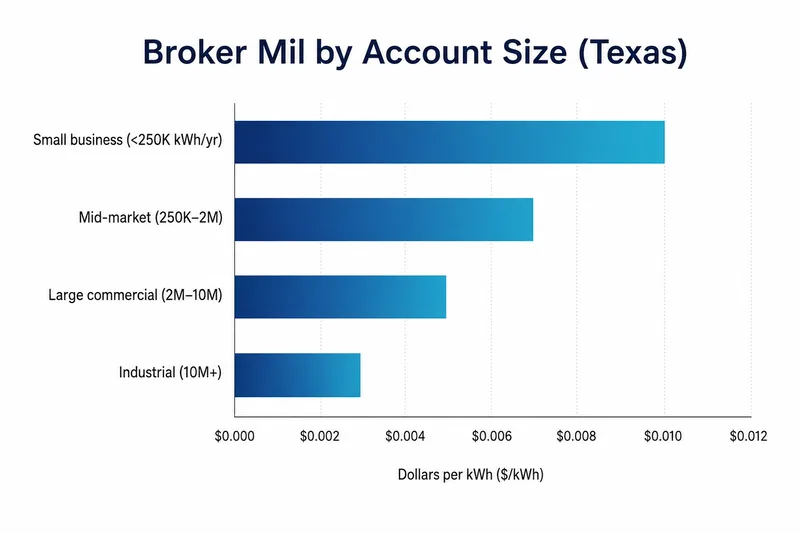
| Account Size | Annual Usage | Typical Broker Mil |
|---|---|---|
| Small business | < 250,000 kWh/yr | $0.005 – $0.010 /kWh |
| Mid-market commercial | 250K – 2M kWh/yr | $0.003 – $0.007 /kWh |
| Large commercial / light industrial | 2M – 10M kWh/yr | $0.002 – $0.005 /kWh |
| Industrial / large portfolio | 10M+ kWh/yr | $0.001 – $0.003 /kWh (often negotiated flat fee) |
A few practical notes on this table.
First, the mil is per kilowatt-hour you actually use, not a flat dollar amount. A small office consuming 80,000 kWh per year at a $0.005 mil pays the broker roughly $400 per year through the supplier — about $33 per month. A mid-market commercial facility consuming 800,000 kWh per year at a $0.004 mil represents roughly $3,200 per year. A large industrial site at 15 million kWh per year at $0.0015 represents around $22,500 per year — meaningful money on either side, but a small fraction of the multi-million-dollar power bill it supports.
Second, the mil is disclosed to you, the customer, before you sign. A reputable Texas broker will tell you exactly what mil they have requested on your rate sheet. We do. If a broker cannot or will not show you their compensation in writing, you should walk away — and we explain why later in this article.
Third, the rate the supplier quotes already includes the mil. There is no separate billing event. The broker fee flows from the supplier to the broker as a back-end commission, paid monthly or quarterly based on actual metered consumption.
Alternative Fee Structures for Very Small Accounts
For very small accounts — single-meter retail or office locations under 100,000 kWh per year — some brokers use a flat monthly fee instead of a kWh-based mil. Common structures include around $12 per month or a low commission of $0.002–$0.005/kWh. The reason: at very low usage, a kWh-based mil generates so little compensation that the broker cannot economically service the account. A flat fee makes the relationship sustainable on both sides.
This is normal and disclosed. What is not normal is a broker who charges a flat fee on top of a kWh mil, or who tries to bill you a "setup fee," "audit fee," or "platform access fee" for the broker relationship itself. Those are red flags, not standard pricing.
Why Broker-Channel Rates Often Beat Direct Quotes — Even with the Mil
This is the part of the math that surprises most buyers.
Texas REPs segment their pricing by acquisition channel. The same supplier will quote different rates depending on whether you walked in through a call-center sales rep, a paid online comparison site, an inbound marketing lead, or a licensed broker. The wholesale and TDU components are the same; the acquisition margin and discretionary pricing differ.
Brokers who manage large portfolios of commercial accounts represent volume, repeat business, and clean operational handoffs to suppliers. They submit polished usage data, vet customers before introducing them, and handle contract execution efficiently. From a supplier's perspective, a broker-introduced account costs less to acquire than a cold inbound call. That cost savings is reflected in the rate sheet.
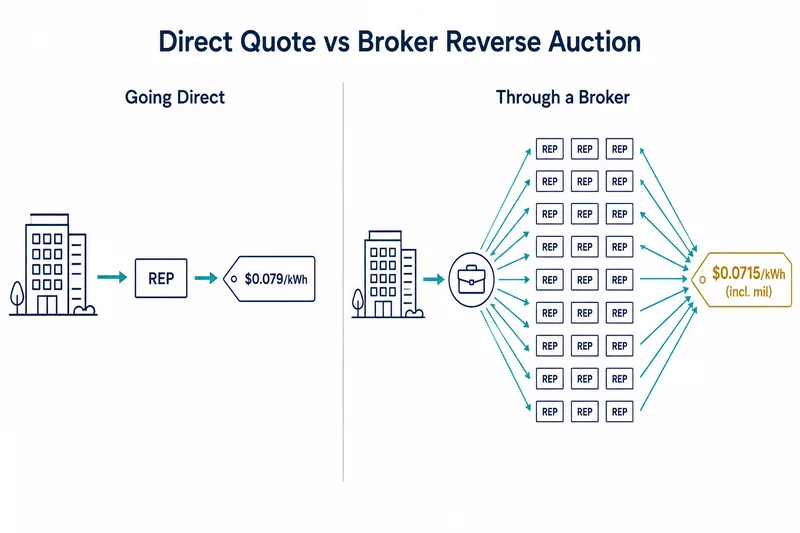
The result, in practice:
- A direct retail quote from one REP for a 500,000 kWh/year business often carries an embedded margin of $0.008–$0.012/kWh above the broker-channel rate sheet, before any negotiation.
- A broker-channel rate, including a $0.004–$0.006/kWh broker mil, will commonly land $0.003–$0.008/kWh lower than the same supplier's direct quote.
- Once a broker submits your account to 20+ suppliers simultaneously and runs a competitive reverse auction, the winning rate is typically 15–25% below the original direct quote you started with.
The objection — "won't a broker cost me more?" — gets the math backwards. The right comparison is not broker rate with mil vs imaginary rate with no mil. It is broker rate with mil vs direct rate with the REP's internal acquisition margin. In Texas commercial electricity, the broker version wins almost every time, because the competitive pressure of running 20+ bids in parallel dwarfs the half-cent or one-cent broker fee.
For the broader case on broker procurement, see why Texas businesses use energy brokers.
What a Real Texas Commercial Account Looks Like (Worked Example)
Let us put numbers on a realistic mid-market commercial account so the math is concrete.
The business: A 12-location restaurant group in Houston with combined annual consumption of 1.2 million kWh and a $0.085/kWh blended all-in rate on its expiring contract.
Going direct: The operations manager calls three suppliers. The best quote that comes back, after some negotiation, is $0.079/kWh — a $7,200/year reduction from the prior rate. The operations manager spends roughly 18 hours over six weeks gathering usage data, fielding calls, reviewing contracts, and following up.
Going through a broker: The broker collects usage data once, submits the account to 23 suppliers, and runs a single reverse-auction round. Five suppliers come back competitive; the winning bid lands at $0.0715/kWh, including a $0.0045/kWh broker mil baked into the rate sheet.
The comparison:
| Scenario | Rate | Annual Cost (1.2M kWh) | Savings vs Direct |
|---|---|---|---|
| Expiring contract | $0.085 | $102,000 | — |
| Direct quote (best of 3) | $0.079 | $94,800 | baseline |
| Broker reverse auction (incl. mil) | $0.0715 | $85,800 | $9,000 / yr |
The broker's mil cost the customer roughly $5,400 over the contract year — and unlocked a $9,000 savings over the best direct quote. The customer's net position is $9,000 better off, and the operations manager spent two phone calls instead of 18 hours.
The same logic scales up and down. Small accounts see narrower absolute dollar savings but similar percentages. Large industrial accounts see smaller percentage savings but very large absolute dollar swings — a 1% rate improvement on a 50 million kWh portfolio is hundreds of thousands of dollars per year.
The 3 Questions to Ask Any Energy Broker About Their Compensation
If a broker is unwilling or evasive about answering any of the following three questions in writing, you have a transparency problem.
1. "What mil are you requesting on my rate sheet, and will you disclose it before I sign?"
A straight-talking broker will give you a number — usually a range tied to contract term — and will confirm in writing that the mil is fixed and known to you before you authorize the contract. The number itself should be in line with the table above. Anything wildly higher than market — say, $0.015/kWh on a mid-market account — is over-margining, and the broker is keeping the savings that should be flowing to you.
2. "Are you showing me every bid you received, or a pre-selected subset?"
This question matters more than the mil itself. A broker who steers accounts toward suppliers who pay them higher commissions, or who presents only two or three "recommended" bids out of twenty received, is not running a competitive auction at all. They are running a managed sales process disguised as a comparison.
Insist on seeing every bid received, side by side, with the broker's mil disclosed on each. Anything less is not a competitive bid; it is sales theater.
3. "If a supplier pays you a higher commission, does that affect which contract you recommend?"
The answer should be no — and a reputable broker will be happy to put that in writing as part of their engagement. Some brokers operate on a flat mil across all suppliers (Elite does); others quietly accept different commissions from different REPs, which creates a conflict of interest. Either model can be defensible, but only if it is disclosed up front. If the broker dodges, you have your answer.
Want to see how we run it? Read more about Elite Energy Consultants.
Red Flag Fee Structures to Walk Away From
Most Texas brokers operate professionally and transparently. A minority do not. Here are the fee structures that should make you close the door:
- Charging an upfront "audit fee" or "engagement fee" while also taking a mil. This is double-dipping. Either the broker is paid through the rate sheet, or they are paid by you for advisory work — not both at the same time.
- Hidden mil shaving. The broker quotes a rate to you, then increases the mil with the supplier after you sign, pocketing the difference. The contract you signed and the rate sheet on file with the supplier should be identical. If a broker resists letting you see the actual signed supplier rate sheet, that is the tell.
- "Free audit + automatic signup" offers where signing up to review your bill quietly authorizes the broker to switch your supplier. Read every authorization form before you sign anything.
- Pressure to sign within 24 hours without giving you time to compare. Real energy markets move daily, but a 24-hour ultimatum on a multi-year commercial contract is almost always a sales tactic, not a market reality.
- Refusal to disclose the mil in writing. Non-negotiable. If a broker will not write down what they are paid, you cannot trust anything else they tell you.
- Pay-to-play rate sheets where the broker only quotes the three suppliers paying them the most. Real reverse auctions include 15+ bids, not 3.
Texas brokers are registered with the Texas Public Utility Commission — you can verify any broker's licensure before you engage.
How Elite Energy Consultants Handles Broker Fees
We are going to be specific about our own model because asking other brokers to be transparent and not being transparent ourselves would be hollow.
Elite Energy Consultants operates on a flat, disclosed mil across all suppliers we quote. The mil is in your rate sheet, in writing, before you authorize the contract. We do not accept different commissions from different REPs, and we do not pre-filter the bids you see. When we run a reverse auction for your business, you see every bid that came back, side by side, with the contract terms, pass-through language, and our mil disclosed on each. You decide which contract to sign.
We do not charge audit fees, engagement fees, retainer fees, platform fees, or onboarding fees. Our compensation is the mil. If we do not save you money, you do not sign — and we do not get paid. That alignment is the reason we have built our practice on long-term commercial accounts and repeat renewals rather than one-off transactions.
FAQ
Do energy brokers cost money in Texas?
Not to you directly. A Texas energy broker is compensated through a small adder — typically $0.003–$0.010 per kWh — built into the supplier's rate sheet. The supplier pays the broker after you sign and consumption begins. You will not see a separate fee, invoice, or charge for the broker on your electricity bill.
Is the broker fee really baked into the supplier's rate?
Yes. The mil is a component of the all-in rate quoted to you, in the same way that wholesale energy cost, TDU charges, capacity, and supplier margin are components of that rate. A reputable broker will disclose the mil to you in writing before you sign so you can see exactly what portion of the rate is their compensation.
Will I get a better rate if I skip the broker and go direct to the REP?
In most cases, no. Texas REPs segment their pricing by acquisition channel. Direct retail quotes typically carry $0.008–$0.012/kWh more embedded margin than broker-channel rate sheets, because acquisition cost through a sales call center is higher than through a vetted broker. Even after the broker's mil is included, the broker-channel rate is usually lower than the direct quote — and the competitive pressure of running 20+ bids simultaneously generally produces a 15–25% improvement over what you would negotiate on your own.
What is a fair broker mil for a mid-market commercial account?
For accounts in the 250,000–2,000,000 kWh per year range, a fair mil is in the $0.003–$0.007 per kWh range, depending on contract length and risk profile. Anything above $0.010/kWh on a mid-market account is high; anything below $0.002 is unusual and may indicate the broker is recovering revenue somewhere else. Always ask for the mil in writing.
Can I negotiate the broker's fee?
Yes — particularly on larger accounts. Industrial customers and multi-site portfolios routinely negotiate the mil down or convert it to a flat annual fee. Mid-market accounts can sometimes negotiate at renewal once a track record is established. The key is that the mil is disclosed and negotiated before you sign the supplier contract, not surfaced after the fact.
How are broker fees actually paid?
The supplier pays the broker a monthly or quarterly commission based on actual metered kWh consumption multiplied by the agreed mil. The payment flows directly from the supplier to the broker. You never write a check to the broker for their commission.
Bottom Line: The Real Comparison
The "do brokers cost money?" question is the wrong question. The right question is: does using a broker produce a lower all-in rate, with better contract terms, than I would get going direct? For the overwhelming majority of Texas commercial accounts, the answer is yes — by 15–25% on the rate itself, plus the contract terms a broker catches that a sales rep would not flag.
The fee math is straightforward and disclosed. The savings math, once 20+ suppliers are competing for your business in a real reverse auction, is what makes this a one-sided trade.
See Every Bid, Every Mil — In Writing
Request a free, no-obligation quote. We will run your account against 25+ licensed Texas suppliers, hand you every bid we receive with our mil disclosed on each, and let you decide.
Get A Free Quote