 By Apollo Kokkinopoulos, CEO
 To read a gas meter at a Texas business, start with the dial farthest left and work right, checking which way each dial turns, since some run clockwise and others counterclockwise. Write down the last number each pointer has passed, even if it has almost reached the next one. Subtract last month's reading from this one to get metered usage, usually in Ccf (hundreds of cubic feet). Your gas utility may then adjust that volume for delivery pressure before it bills you, which is why a gas meter reading often won't match the usage on your bill exactly.
This guide follows the number from the meter to the bill, using the rules and tariffs Texas gas utilities have on file. It covers the parts of a commercial meter set, dial and digital indexes, how to turn two readings into usage, the pressure correction that turns metered Ccf into billed Ccf, conversion to therms and MMBtu, and what to do when the numbers don't agree. One ground rule first: read, don't touch. The meter, the regulator, and the valves belong to the utility. If you smell gas, Texas Gas Service's instruction is to leave the area immediately and then call 911 and the utility.
Who Owns and Reads a Commercial Gas Meter in Texas
Your gas meter belongs to your local distribution company (LDC), the regulated utility that delivers gas to the building. Depending on where you are, that's CenterPoint Energy (its Houston, Texas Coast, South Texas, and Beaumont/East Texas rate areas), Atmos Energy's Mid-Tex division (Dallas-Fort Worth, Waco, and much of North and Central Texas), or Texas Gas Service (areas including Austin, El Paso, McAllen, and Galveston). It isn't your gas supplier's meter, and it isn't a broker's. Elite Energy Consultants reviews gas bills; we don't read, test, install, or replace meters.
The Railroad Commission's quality-of-service rule requires each gas utility to "provide and install and will continue to own and maintain all meters necessary for measurement of gas delivered to its customers," and says all gas a utility sells "must be charged for by meter measurements" (16 TAC §7.45). The utility also chooses the equipment. Atmos Mid-Tex's tariff reserves the right to install "a digital, automated meter reading, automated metering infrastructure, or advanced metering systems meter" (Atmos Mid-Tex tariff, RRC report GFTR0048). Texas Gas Service reads meters "as nearly as may be practical on the same day of each calendar month" (Texas Gas Service Rules of Service §12.2).
Where a utility's tariff lets a business buy gas from a supplier, the utility still delivers the gas and reads the meter. Eligibility differs by utility, and our guide to small business natural gas rates in Texas sets out who qualifies. Municipal gas systems, such as CPS Energy in San Antonio, set their own rules and aren't covered here.
The Parts of a Commercial Gas Meter Set
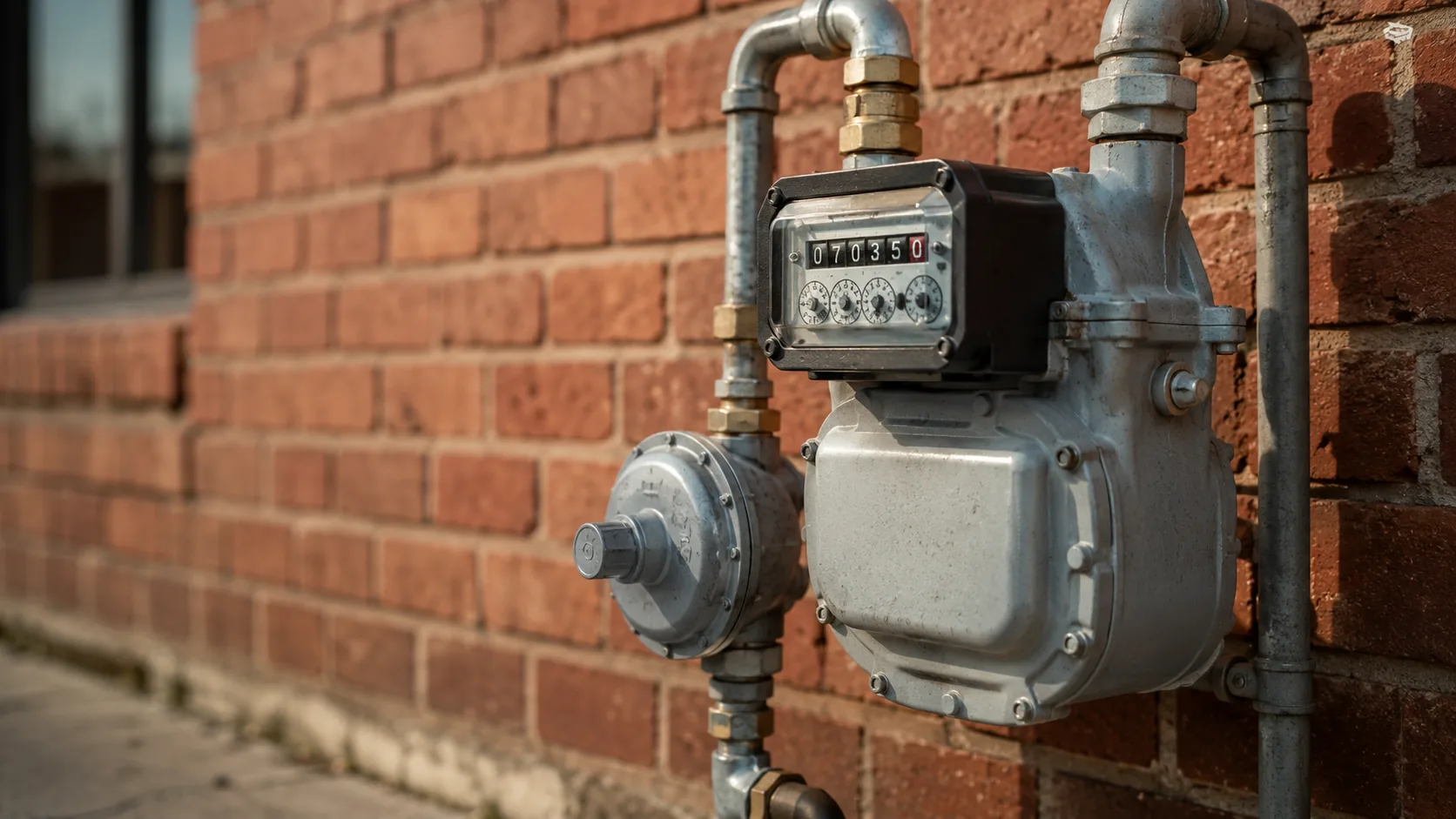
Commercial meter sets vary with the size of the load, so yours may have fewer parts than the illustration below, or different ones. What matters is knowing which part you're reading from and which parts to leave alone.
| Part | What it does |
|---|---|
| Regulator | Holds gas at the delivery pressure. Texas Gas Service's Standard Serving Pressure is 4 ounces (0.25 psi), or 7 inches of water column, above the standard atmospheric pressure in the area served. |
| Pressure gauge | Shows delivery pressure, where one is fitted. |
| Meter body | Measures the gas passing through. Texas tariffs name positive-displacement, turbine, and orifice meters for larger loads. |
| Index | Counts the volume, on dials or digits, and must show the units it counts. |
| Volume corrector | On larger loads, corrects measured volume for pressure, or pressure and temperature. |
| Remote-read module | Sends readings to the utility without a site visit. |
| Meter number | Identifies the meter itself. The one in the illustration is a sample. |
Texas Gas Service's Rules of Service define automated meter reading (AMR) as "the process of remotely reading a Gas meter," an electronic radio transponder (ERT) as "a device that assists with remotely reading a Gas meter," and electronic flow measurement (EFM) as "an electronic means of obtaining readings on a Gas meter." A remote-read device carries the reading; it doesn't replace the index. The same tariff says "the index of the meter shall be the sole determinant of volumes passing through the meter" (QSR-TGS definitions and §13.3). For larger loads, CenterPoint's large-volume schedule covers orifice, positive-displacement, and turbine meters (CenterPoint GSLV-630-I), and Texas Gas Service sets minimum test intervals for turbine and orifice meters on special-service accounts (QSR-TGS §12.10).
How to Read a Gas Meter Index
Reading a Dial Index
Texas Gas Service publishes three rules for reading a dial gas meter:
- Left to right. "Read the needle in each dial, starting with the one that's farthest left."
- Check the direction. "Some numbers are shown in a clockwise position on the dials, while others run counterclockwise."
- Behind the needle. "Record the last number the needle has passed, even if the needle has almost reached the next higher number."
Write the digits down in order, and that's the reading.
If you can't tell which number a pointer has passed, take a clear photo of the whole index and ask the utility. Texas rules list "the customer's right to be instructed by the utility how to read his or her meter" among the information a gas utility must make available to customers (16 TAC §7.45).
Reading a Digital Index
Some meters show the reading as a row of digits instead of dials. Read the digits left to right and write them down in the same order. If the index shows extra digits, dials, or markings and you aren't sure which ones make up the billing reading, don't guess. Ask the utility, and compare your figure with the reads printed on the bill.
What Unit Is the Index Counting?
Look for the unit label on the index. The Railroad Commission's rule says "each meter must indicate clearly the units of service for which charge is made to the customer" (16 TAC §7.45). Texas Gas Service's standard unit of measurement is "one hundred (100) cubic feet (Ccf)" (QSR-TGS §13.2). If your index counts single cubic feet, divide the difference by 100 to get Ccf. Ten Ccf make one Mcf. The units themselves are explained in our guide to Mcf, Ccf, MMBtu, and therms on a Texas commercial gas quote.
Meters With a Volume Corrector or Remote Read
Where the volumes justify the cost, Texas Gas Service may install "pressure or pressure and temperature compensating measurement equipment" that corrects "the actual measured volumes in accordance with Boyle's Law" (QSR-TGS §13.4(a)). If your meter has a corrector, ask the utility which reading your bill is based on before you compare figures. A remote-read module doesn't change what you read on the index. It lets the utility collect the reading without a visit.
Gas Meter Reading: Turning Two Readings Into Usage
Usage is the difference between two readings. This example is illustrative, not taken from a customer account, and the index is labeled in hundreds of cubic feet.
| Illustrative example | Index reading |
|---|---|
| Current reading (this read date) | 6,249 |
| Previous reading (last read date) | 5,821 |
| Metered usage | 428 Ccf |
Your bill gives you what you need to check that subtraction. When the utility reads the meter, the bill must show "the date and reading of the meter at the beginning and end of the period," "the number and kind of units billed," the applicable rate schedule, and "a distinct marking to identify an estimated bill" (16 TAC §7.45).
Two checks prevent most confusion. First, compare dates. A photo taken mid-cycle won't match either read on the bill. Second, if the current reading is lower than the previous one, either the index has rolled over past its highest number or the meter has been changed, so confirm the meter details with the utility before you do the math.
Pressure Correction: Why Billed Ccf Isn't Metered Ccf
A cubic foot of gas isn't a fixed quantity. At higher pressure, more gas fits in the same space. So Texas gas utilities define their unit at a stated pressure and correct for the pressure your gas is actually measured at. That's why the billed Ccf on your statement can be higher or lower than the 428 Ccf your meter recorded.
Don't confuse this with the pressure base gap between utility volumes and NYMEX or EIA figures, which is a reporting convention covered in our Texas commercial gas units guide. The correction described here happens at your meter.
Texas Gas Service's Constant Factor
Texas Gas Service publishes the whole method. Its Standard Serving Pressure is 4 ounces above the standard atmospheric pressure in each area it serves. To bill every customer on the same basis, it converts to a Common Billing Pressure of 14.65 psi using a Constant Factor, "determined by dividing the Customer's Standard Serving Pressure by 14.65." The factor "is multiplied by the change in meter readings shown on the Customer's bill to calculate a Billed Ccf volume," and for customers served at 4 ounces it "will be on their monthly bill" (QSR-TGS definitions and §13.1). Its small commercial schedule bills "All Ccf metered @14.65 psi" and notes that "not all customers receive service at the pressure base of 14.65 psi" (Rate Schedule 20-TGS).
Here is the 428 Ccf example run through the tariff's published factors for a sample of areas:
| Texas Gas Service area | Atmospheric pressure (psi) | Standard serving pressure (psi) | Constant factor | 428 metered Ccf bills as |
|---|---|---|---|---|
| El Paso | 12.80 | 13.05 | 0.8908 | 381.26 Ccf |
| Andrews | 13.10 | 13.35 | 0.9113 | 390.04 Ccf |
| Pecos | 13.35 | 13.60 | 0.9283 | 397.31 Ccf |
| Austin | 14.40 | 14.65 | 1.0000 | 428.00 Ccf |
| McAllen | 14.65 | 14.90 | 1.0171 | 435.32 Ccf |
| Galveston | 14.70 | 14.95 | 1.0205 | 436.77 Ccf |
The factors in the tariff's table run from 0.8908 in El Paso to 1.0205 in Galveston, and the spread comes from altitude. Atmospheric pressure is lower in El Paso, so gas measured there at 4 ounces above atmospheric is less compressed than gas on the 14.65 psi billing basis, and the factor scales the volume down. A factor below 1 isn't a discount, and a factor above 1 isn't an overcharge. Both put your gas on the same basis as everyone else's. These factors apply to Texas Gas Service areas only.
Elevated Delivery Pressure
Some commercial equipment takes gas above the standard 4 ounces. Texas Gas Service allows a higher serving pressure "at the Company's option," and adds that "increases in serving pressure because of the inadequacy of the Consumer's facilities shall not be permitted" (§13.1). Its definition says the Constant Factor "will be further adjusted for non-residential Customers who have requested an elevated meter pressure." The tariff gives two ways to make the correction (§13.4):
- Compensating equipment, installed "whenever the cost of this equipment is justified by the volumes served."
- Factor billing, used "whenever the volumes to be delivered are too small to justify special metering." The factor is found "by dividing the actual serving pressure by the Standard Serving Pressure, both expressed in absolute units based on the standard atmospheric pressure in the area."
The table below works that through for gas delivered at 2 psi above atmospheric pressure, using the tariff's own pressure table. It takes the §13.4 factor (absolute delivery pressure ÷ Standard Serving Pressure) and multiplies it by the area's Constant Factor, which comes to absolute delivery pressure ÷ 14.65. The elevated-pressure factors are our arithmetic, not figures printed in the tariff, and the factor on your bill or from the utility is the one that counts.
| Area | Delivery pressure | Factor | 428 metered Ccf bills as |
|---|---|---|---|
| Austin | 4 oz (standard) | 1.0000 | 428.00 Ccf |
| Austin | 2 psi above atmospheric | 1.1195 (16.40 ÷ 14.65) | about 479.1 Ccf |
| El Paso | 4 oz (standard) | 0.8908 | 381.26 Ccf |
| El Paso | 2 psi above atmospheric | 1.0102 (14.80 ÷ 14.65) | about 432.4 Ccf |
Same gauge pressure, different factor, because the two cities start from different atmospheric pressures.
CenterPoint and Atmos
CenterPoint's General Rules define a cubic foot of gas at "a gauge pressure of four (4) ounces above atmospheric pressure." Where gas is measured above 4 ounces, measurement follows "the same basis as that outlined in the rate schedules for Large Volume Natural Gas Service" (CenterPoint General Rules and Regulations). That large-volume schedule measures a cubic foot at 14.65 psi absolute and 60°F, and assumes atmospheric pressure is 14.7 psi "irrespective of actual elevation or location of the point of delivery" (GSLV-630-I). CenterPoint's small and large commercial schedules each publish their commodity charge at three pressure bases, 14.65, 14.73, and 14.95 (GSS-2099-I). The schedules don't say which base applies to a given customer, so check your bill or ask CenterPoint rather than working out a factor yourself.
Atmos Mid-Tex's tariff, in the definitions for its Rider CRR, defines a Ccf as 100 standard cubic feet at "fourteen point sixty-five (14.65) pounds per square inch, absolute" and 60°F (RRC tariff report GFTR0048). Its method for correcting volume at an elevated delivery pressure isn't set out in the sections of that report we reviewed, so ask Atmos how it handles your delivery pressure.
From Billed Ccf to Mcf, Therms, and MMBtu
Once you have billed Ccf, the volume conversion is simple: 10 Ccf is 1 Mcf. Getting to energy units takes one more number, the heat content of the gas in Btu per cubic foot. EIA's Texas figure for June 2026 was 1,013 Btu per cubic foot, in its release of August 31, 2026 (EIA, heat content of natural gas deliveries in Texas). Continuing the El Paso example:
- 381.26 billed Ccf ÷ 10 = 38.126 Mcf
- 38.126 Mcf × 1.013 ≈ 38.62 MMBtu
- 38.62 MMBtu × 10 ≈ 386 therms
Treat that as an estimate. EIA's number is a statewide average for gas delivered in Texas, not a measurement of the gas through your meter. Your bill may not show a Btu factor at all. The commercial sales schedules reviewed for this guide (CenterPoint GSS and GSLV, Atmos Mid-Tex Rate C, and Texas Gas Service Rates 20 and 25) charge by volume, per Ccf or partly per Mcf on CenterPoint's large-volume schedule, so heat content isn't needed to calculate those charges. It matters where energy is the billing unit. Atmos Mid-Tex Rate I bills "Customer and MMBtu charges," and Texas Gas Service's tariff sets out how heating value is calculated "in those cases in which heating value is used as the billing unit" (QSR-TGS §13.3). CenterPoint itself uses "an assumed Btu factor of 1.025" when it converts past months measured in Mcf only into MMBtu for transportation contract demand (CenterPoint Rate Schedule T-93).
Why a Texas account shouldn't use the national conversion factor, and how pressure bases differ between utilities and the futures market, are both covered in the gas units guide.
How the Reading Drives Your LDC Charges
Your meter reading, corrected for pressure, is the quantity most lines on a gas bill multiply. The rate schedules show the structure. We've left out dollar amounts, which move with rate filings and periodic gas cost adjustments; the linked schedules carry the current ones.
| Utility and schedule | Who it covers | Billing unit | How your reading enters the bill |
|---|---|---|---|
| CenterPoint GSS-2099 | Commercial and industrial use averaging 150,000 cubic feet a month or less in the prior calendar year | Ccf | Customer charge + commodity charge "for all Ccf billed" at the applicable pressure base + purchased gas adjustment per Ccf + riders and taxes |
| CenterPoint GSLV-630 | Use averaging more than 150,000 cubic feet a month | Ccf for the commodity charge; the sales unit is one Mcf | Customer charge + commodity charge per Ccf billed + purchased gas adjustment per Mcf + riders and taxes |
| Atmos Mid-Tex Rate C | Commercial customers, and industrial customers using under 30,000 Ccf a year | Ccf | Customer charge + commodity charge per Ccf + Rider GCR gas cost + other riders and taxes |
| Atmos Mid-Tex Rate I | Industrial customers with maximum daily use under 200 MMBtu at one point of delivery | MMBtu | "Customer and MMBtu charges" + riders |
| Texas Gas Service 20 and 25 | Rate 20 below 3,001 Ccf of annual normalized volume; Rate 25 at 3,001 Ccf or more | Ccf at 14.65 psi | Customer charge + charge on "All Ccf metered @14.65 psi" + cost of gas + riders and taxes |
Two things follow. First, the per-unit charges multiply pressure-corrected volume, so the pressure factor carries through to every usage-based line. Fixed monthly charges, such as the customer charge, don't depend on the reading, and riders such as franchise fees and taxes follow their own formulas. Second, rate-class thresholds are written in volume too. CenterPoint's line sits at an average of 150,000 cubic feet a month, which is 1,500 Ccf, and Texas Gas Service's at 3,001 Ccf a year. Read Ccf as Mcf, or cubic feet as Ccf, and you misjudge which class you belong in by a factor of ten or a hundred.
For how these delivery charges sit alongside the commodity price and basis, see commercial natural gas rates in Texas. The Railroad Commission keeps tariffs and rate schedules for regulated gas utilities on file if you want the complete schedule for your account.
Large Accounts and Transport Meters
On large and transportation-service accounts, a meter reading usually means data sent automatically to the utility, and energy is handled in MMBtu.
- CenterPoint. Its transportation schedule applies where consumption will be, on CenterPoint's best estimate, "at least 10 MMBtu per day" (T-93). Its general terms state that "wireless telemetering is required for service under these General Terms," define the cubic foot at 60°F and 14.65 psi absolute, and let CenterPoint bill the cost of manual meter reads in some circumstances, at no less than $500.00 per billing period (CenterPoint General Terms and Conditions for Transportation).
- Texas Gas Service. "Electronic flow measurement (EFM) may be required for Customers under transportation service, at the Company's sole discretion," and the customer may have to reimburse installation and ongoing costs (T-TERMS-TGS).
- Atmos Mid-Tex Rate I. "Customer must have the type of meter required by Company" and "must pay Company all costs associated with the acquisition and installation of the meter" (RRC tariff report GFTR0048).
If you're weighing transportation service, the step-by-step guide to buying natural gas for a Texas business covers eligibility and nominations. A broker comparing supply offers works from your utility's usage history rather than a photo of the meter, and what a letter of authorization means explains how you give a broker permission to request it.
When the Meter Reading and the Bill Don't Match
Work through these in order before you assume the meter is wrong:
- Compare read dates. Use the beginning and ending reads printed on the bill, not a reading you took on a different day.
- Look for an estimate. An estimated bill must carry a distinct marking. Texas Gas Service says that, if practical, it takes an actual reading after two consecutive estimated bills (QSR-TGS §12.2).
- Check the factor and the unit. Confirm the pressure or constant factor, and whether the bill is in Ccf, Mcf, or MMBtu.
- Check the rate schedule. The bill must show "the applicable rate schedule title or code." If it has changed, so have the charges.
- Ask for a special reading. Texas Gas Service will read a meter on request and may charge for it, but the charge is refunded if the original reading was in error (QSR-TGS §12.2).
- Request a meter test. Your rights are in the table below.
- Escalate if it's still unresolved. The utility must make available, on request, the regulatory authority you can file a complaint with and how to contact it.
| Situation | What 16 TAC §7.45 says |
|---|---|
| Estimated bills | Allowed "where there is good reason for doing so," provided "an actual meter reading is taken at least every six months" |
| No access for a second consecutive month | The utility must send a postcard asking you to read the meter, if it can be read without significant inconvenience or special tools or equipment |
| Meter test on request | Free if no test was done for the same customer at the same location in the previous four years; otherwise the fee can't exceed $15 or the fee in the utility's tariff |
| Meter off by more than 2.0% | Any test fee is refunded, and previous readings are corrected for the last six months or since the last test of the meter, whichever is shorter |
| Meter not registering | The utility may charge for gas used but not metered for no more than three months before the problem was found |
The tariffs set the same accuracy line. Texas Gas Service sets the accuracy limit of its meters at "two percent (2%) fast or slow" (QSR-TGS §12.5), and CenterPoint bases its periodic test intervals on at least 70% of randomly sampled meters staying within 2% fast to 2% slow (CenterPoint General Rules and Regulations). Section 7.45 sets minimum service standards for residential and small commercial customers. It applies directly in unincorporated areas, and gas utilities must write the same standards into their service rules for incorporated areas unless a city has set conflicting standards. The CenterPoint and Texas Gas Service rules reviewed carry matching meter-test provisions, but on a large or special-contract account, check your utility's tariff and your contract.
Frequently Asked Questions
How do you read a gas meter with dials?
Start with the dial farthest left and read each one in turn. Some dials run clockwise and others counterclockwise, so check the direction of each. Write down the last number each pointer has passed, even if it has almost reached the next one. The digits in order are your reading. Subtract the previous reading to get usage.
How do I calculate gas usage from my meter reading?
Subtract the previous reading from the current one, using the read dates on your bill rather than a photo taken mid-cycle. Check the unit label on the index to see whether the difference is in cubic feet or hundreds of cubic feet (Ccf). Then apply the pressure factor your gas utility uses to get the billed volume.
Why is the usage on my gas bill different from my meter reading?
Often because the utility corrects metered volume for pressure. Texas Gas Service, for example, multiplies the change in readings by a constant factor based on local atmospheric pressure, adjusted further for elevated delivery pressure. Other common causes are a photo taken between read dates, an estimated bill, or a meter fitted with a volume corrector. If none explains it, ask for a meter test.
What is the constant factor on a Texas gas bill?
It is Texas Gas Service's pressure factor. The utility divides the Standard Serving Pressure in your area by a Common Billing Pressure of 14.65 psi, then multiplies the change in meter readings by the result to get billed Ccf. Published factors range from 0.8908 in El Paso to 1.0205 in Galveston, and the factor is adjusted for customers served above 4 ounces.
Does a Texas commercial gas bill use Ccf, Mcf or therms?
Most small and mid-size commercial sales accounts are billed in Ccf. CenterPoint's General Service-Small schedule, Atmos Mid-Tex Rate C and Texas Gas Service Rates 20 and 25 all charge per Ccf. CenterPoint's large-volume schedule uses an Mcf sales unit, while Atmos Mid-Tex Rate I and CenterPoint transportation service use MMBtu. Check the units billed on your statement.
How do I convert a gas meter reading to therms or MMBtu?
Divide billed Ccf by 10 to get Mcf, then multiply by a heat content in Btu per cubic foot. EIA's Texas figure for June 2026 was 1,013, so 381.26 billed Ccf (38.126 Mcf) is about 38.62 MMBtu, or roughly 386 therms. That is a statewide average, so treat the result as an estimate unless your utility gives you its own figure.
Who reads my gas meter if I buy gas from a supplier?
Your local gas utility. Texas rules require each gas utility to provide, install, own and maintain the meters that measure the gas it delivers, and gas a utility sells must be charged for by meter measurement. Buying gas from a supplier, where your utility's tariff allows it, doesn't change who owns or reads the meter.
Can I get my commercial gas meter tested in Texas?
Yes. Texas's quality-of-service rule, which the CenterPoint and Texas Gas Service service rules repeat, requires the utility to test your meter on request. The test is free if none was done for you at that location in the previous four years; otherwise the fee is capped at $15 or the fee in the utility's tariff. If the meter is off by more than 2.0%, the fee is refunded and past readings are corrected.
The Bottom Line
Reading a gas meter takes a minute: left to right, last number passed, subtract. Matching the reading to the bill is the real work. Metered volume becomes billed volume through a pressure factor, billed volume drives nearly every usage charge, and your billing unit and rate class decide how those charges are applied. If the building also has electric service, how to read a commercial electric meter does the same job for kWh and demand.
Want a Second Look at Your Gas Bill?
Send us a recent gas bill. We'll confirm your utility, rate schedule, billing unit, and pressure factor, check that the reads add up, and tell you whether your account can shop its gas supply, at no cost to you.
Upload My Gas Bill for ReviewNot sure which utility or rate schedule serves your meter? That's the first thing our commercial natural gas brokerage in Texas establishes, before any pricing conversation starts.
Tariff and rule text checked against the publishers' documents in September 2026. Rate schedules change on rate-filing cycles, so your bill and your utility's current tariff govern. The elevated-pressure factors are derived from Texas Gas Service's published method and aren't printed in its tariff. All meter readings, meter numbers, and examples are illustrative, and this article is general information, not a billing determination.